6 Chrome extensions that will save your time

It changes all websites to have a dark color palette. it is amazingly useful for browsing websites that don’t have a dark theme at night

Many a time amazon discounted prices are higher than regular and the extension gives you a price history of the product with the ability to send you a notification when it reaches a desirable price

It blocks trackers (so companies can’t get your web browsing history and build a profile on you) and is a solid privacy extension.

Make it easier for you to hide all of your tabs at once just by clicking on a button. they are then saved as bookmarks in a separate folder. afterward, the panic button turns green and shows you how many tabs are currently hidden.

Removes formatting on websites to make them look like plain text so you can browse at work without attracting attention.

You mostly look like you’re reading serious boring sites.

A website wants you to turn off adblocker to continue browsing? right click and f*uck that shit.

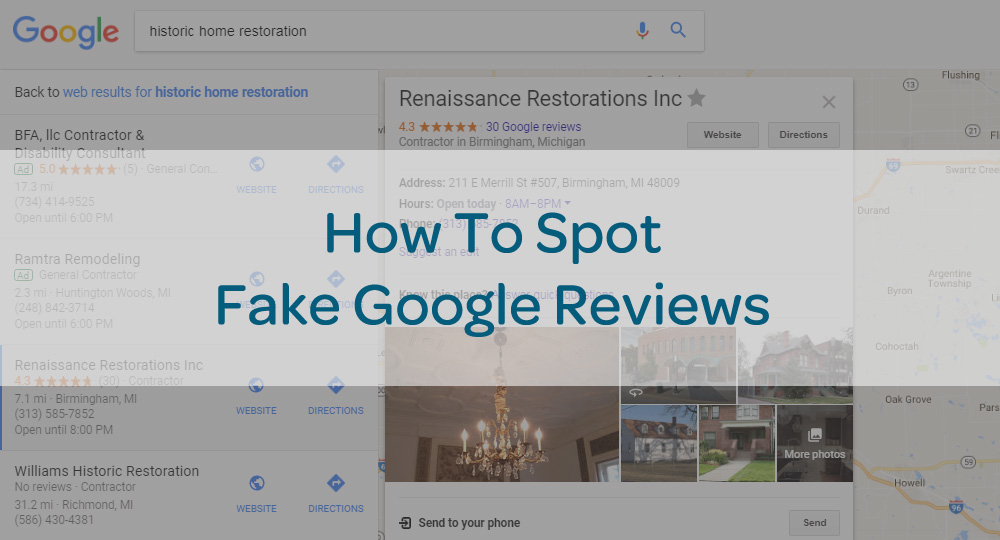
How to Spot Fake Google Reviews: Details here

Fake Google reviews can be hard to spot if you’re a customer, but if you’re a small business, it’s easy to tell when they appear. You’d never met the person before, and their profile only has one review. That review is for your business.

Google will instantly eliminate surveys that abuse its strategies, including counterfeit ones.

Here, we’ll examine how to recognize counterfeit Google Audits, then, at that point, we’ll list the moves toward reporting them to research and eliminate them from your posting.

And since Google is a third-party site, businesses can’t just take the review down. They need to go through Google’s reviewal process to appeal the fake review.

  • Pay attention to the details in the review.
  • Look at the complexity of words.
  • Check for repeated exclamation points.
  • Examine the reviewer’s name and avatar.
  • Flag reviews without comments.
  • See if the reviewer has reviewed other businesses.
  • Look at how frequently the reviewer leaves reviews.
1- Pay attention to the details in the review.

Fake reviews can sometimes be hard to spot, especially when the reviewer doesn’t want you to know it’s fake.

This implies they need to give explicit subtleties with regard to why their experience was negative.

Counterfeit surveys will frequently specify subtleties that don’t have anything to do with the protest. For instance, one investigation discovered that phony inn surveys frequently included more data about the commentator’s family than it did about the lodging experience.

Since the reviewer doesn’t have a real interaction to write about, the details they’ll fabricate will focus more on their personal stories.

2- Look at the complexity of the words.

To write a deceptive message, reviewers need to use more cognitive function than they would if they were telling the truth. Since they’re creating fictional details in their minds, their brains need to work harder than they would if they were recalling a recent memory.

This additional work normally brings about a message that utilizes more straightforward phrasing. As a matter of fact, research shows that when commentators attempt to be underhanded, they’re bound to utilize words that aren’t as lengthy or complex. That’s because their focus is on creating a believable story, rather than flexing their vocabulary.

3- Check for repeated exclamation points.

Another common theme of fake customer reviews is the repeated use of exclamation points. One study from MIT found that deceptive reviews often contain more exclamation points than genuine reviews.

Counterfeit analysts trust that by adding these imprints, they’ll stress the gloomy feelings behind their criticism. Nonetheless, honest surveys are bound to zero in on the genuine occasions that were pessimistic, as opposed to how the analyst is feeling at the time. After all, if a customer is sincerely upset with your company, they’ll want to provide thoughtful, actionable feedback instead of appearing like they’re overreacting to the situation.

4- Examine the reviewer’s name and avatar.

One clear giveaway can be the name and avatar associated with the review. Since Google Reviews require an email address, people who leave fake reviews will often create fake accounts.

Really look at the analyst’s name and symbol. While it’s not ensured to uncover the credibility of the survey, you could discover a contender attempting to act deceptively or an individual who didn’t wind up utilizing your administrations by any means, yet at the same time felt a sense of urgency to post a survey.

5- See if the reviewer has reviewed other businesses.

One more method for checking the record’s authenticity is to check whether they’ve audited different organizations, particularly ones in your industry. In the event that the client has no different surveys or appears to continually flaunt about a particular contender, there’s a superior opportunity the survey is phony.

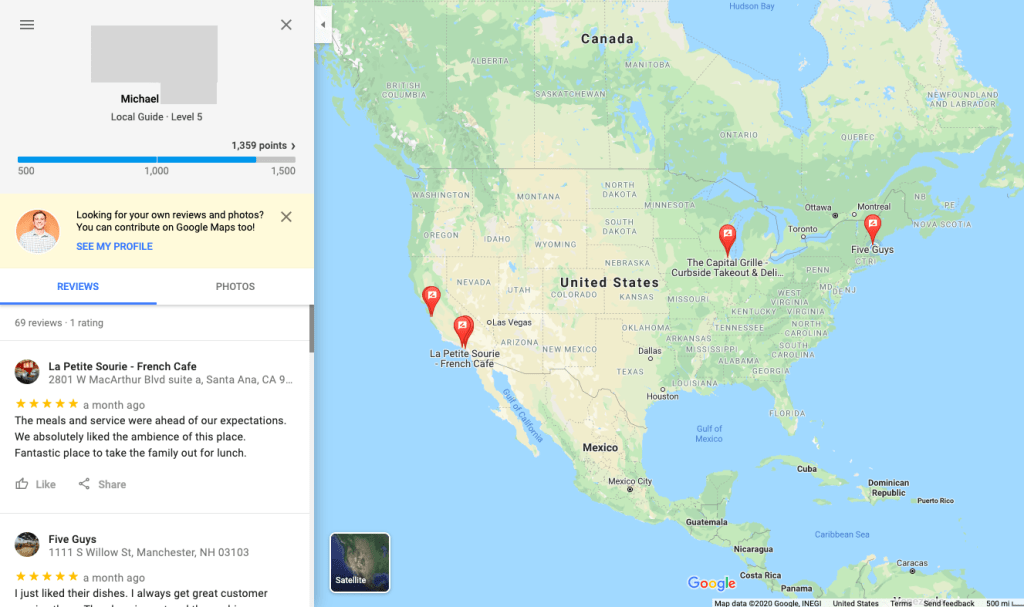
To check, navigate to the review and click on the reviewer’s name. This should launch a side panel that shows you all of the reviews the person has left, similar to the image below.

In this view, you can see the businesses that the person has reviewed as well as any photos that the reviewer has uploaded. You can also assess their “contribution points” which are added as the person submits more reviews. The higher the number of points, the more likely that the review is real.

6- Look at how frequently the reviewer leaves reviews.

Using that same interface shown above, you should also check to see how frequently the person leaves reviews. People who are paid to write fake reviews often submit them in bulk, then make another record to keep away from recognition.

Fortunately, you can use the account summary to check when reviews were left. If you notice that the reviewer has left multiple reviews on the same day, the reviews are likely fake.

7- Flag reviews without comments.

This makes it simpler for tricky analysts to pass on counterfeit surveys and harder for your business to get them.

When in doubt of thumb, you ought to signal all regrettable surveys that do exclude a remark. While a portion of these might be certifiable, your most significant surveys are ones that make sense of why your business is perfect or why it missed the mark regarding assumptions. Audits without remarks don’t offer a lot to different clients or your business, so they’re worth researching on the off chance that you suspect they’re fake.

Now that you know how to spot a fake review, let’s talk about how you can remove it.

Google passkeys for password-less future: Know what is it and how it works

Google passkeys are currently available for developers to test via Google Play Services beta

Google passkeys are currently available for developers to test via Google Play Services beta

Ahead of the final rollout, Google has announced the release of its passkey support for developers on Android and Chrome. The American software giant says ‘passkey’ is a safer substitute for passwords and other perishable authentication factors. It will be integrated with the Google Password Manager to simplify sign-ins across devices, websites, and applications — no matter the platform. But what is Google passkey and how does it work? Let’s find out:

Passkeys: What is it

Passkeys are a new type of login credential that replaces passwords. The authentication requires either biometric authentication — such as a fingerprint or facial recognition — or a PIN or swipe pattern used with Androids for access. According to Google, they are built on industry standards and work across different operating systems and browser ecosystems, and can be used for both websites and apps. They follow familiar user experience patterns and build on the existing experience of password autofill.

Passkeys: How it works

Google says its passkeys work similarly to using a saved password in the Google Password Manager. To prevent lockouts in the case of device loss, passkeys are backed-up and synced through the cloud on users’ phones and computers. The passkeys can be used to sign in to apps and websites on other nearby devices via users’ phones.

Users can create and use passkeys on Android devices, which are synced through the Google Password Manager. On Android and other supported platforms, developers can build passkey support on their sites for end-users using Chrome via the WebAuthn API. Currently, developers can use Chrome Canary and sign up for the Google Play Services beta to test this.

How to create passkeys:

Step 1: Through settings on the Android 9 device and later, click on Create a Passkey

Step 2: Confirm the passkey account information

Step 3: Present fingerprint, face, or screen lock when prompted

Earlier, Apple released a similar Passkey feature with its iOS 16 update that allows users to use their Apple devices to log in to websites and services without requiring passwords. Apple, Google, and Microsoft partnered with the FIDO Alliance and the World Wide Web Consortium (W3C) earlier this year, for removing passwords for user authentication across the platforms.

Google Pixel Buds Pro review

A long list of features, snug fit, ease of use, and uniform experience across Android devices put the Google Pixel Buds Pro a notch above other wireless earbuds in the premium segment

  • Design

Google has designed the Buds Pro in the usual format, having a pebble-like case with the buds inside the oval-shaped nests. The design is neat and the build quality feels sturdy in its matte finish. The case comes with a Type-C port which is convenient to charge, and a physical reset button on the back. It will help in connecting to new devices. The front has an LED that blinks when the case is opened up. It indicates pairing and battery status as well. The orange light suggests that the buds are low on battery whereas the white blinking light confirms it is fully charged.

The buds have a peculiar design as well; they look more like a mouse when placed on flat surfaces. They don’t really go very deep into the ear canal and thus avoid in-ear pressure. In my case they fit well enough, but I had to adjust them or push deeper while on the move. The Buds themselves are lightweight and easy to wear; they are water and sweat-resistant, and hence have a wide variety of use cases. 

  • Connectivity

The Pixel Buds Pro pairs with two devices simultaneously, but can be used with only one at a time. I have been using it on Android and iOS without any hiccups. Google’s fast pairing makes it connect in a second with Android devices.

The Fast Pair app lets users select other functions for the Buds as well and is handy to have on the playback device. There is a Pixel Buds app that collects statistics regarding the seal check. This will suggest tips and tricks for an immersive audio experience. You can also use the Google Assistant on the buds with a tap, after setting it up on the app first. 

  • Performance

The Google Pixel Buds Pro has a remarkable active noise cancellation (ANC) feature that is intelligent in many ways. The transparency mode makes it the preferred TWS for a long period of use. The ANC works perfectly on the Pixel Buds Pro to cut out the extra noise. Even the swirling of air couldn’t pass through it, which makes it a suitable choice for office calls. The transparency mode is similar to an open-air design, which we noticed in the Sony LinkBuds. It allows some ambient noise to make us aware of the surroundings, without amplifying it.

The touch controls on the buds are responsive as well. You can control the volume, skip tracks and trigger the Assistant with the Pixel Buds Pro, thanks to a sensitive interface. The volume can be adjusted by swiping forward and backward on the buds. Tap once to play or pause the audio and to answer a call. Do it twice for the next song or to reject the call. For the previous track, you have to tap it thrice. 

The sound output on the Pixel Buds Pro is fine. You won’t get very discerning clarity where you can distinguish between the instruments, but overall, the feeling is conveyed. The Pixel Buds Pro is meant for daily users and not very ardent audiophile buyers, where details matter. Having said that, the audio on the Buds Pro is pleasing to say the least. The bass and treble are present but do not expect them to go along with higher levels of volume. 

  • Battery 

The Google Pixel Buds Pro goes for seven hours of playtime. The case stores an additional 12 hours for them to go on for a longer duration as required. The buds get charged quickly and even a 10-15 minutes charge is good enough to give it an hour of playback. The Pixel Buds Pro supports wireless charging as well but takes ages to charge completely.  

  • Conclusion

The Google Pixel Buds Pro offers high-quality ANC along with seamless pairing, good battery life, and pleasing audio. The transparency mode adds an additional layer for listeners to use it for long periods of time. The call clarity on the Pixel Buds Pro is great as well. 

Despite these features, Google Pixel Buds Pro falls in a difficult terrain of premium TWS where competition is brutal and tastes are more refined and developed

Google announces new features for Meet, Chromebooks to empower students

With an aim to empower teachers and students, tech giant Google on Wednesday announced that it is sharing new updates to Chromebooks, Google Classroom and Google Meet.

With an aim to empower teachers and students, tech giant Google on Wednesday announced that it is sharing new updates to Chromebooks, Google Classroom and Google Meet.

For those using the Google Workspace for Education Plus or Teaching and Learning Upgrade, Google said it is adding features focused on increasing interconnectivity, control and efficiency in the classroom to Google Meet.

“Now, Meet calls can be auto-transcribed directly into a Google Doc for easy lesson reviews and the ability to search for keywords and concepts,” Shantanu Sinha, Director, Google for Education, said in a blogpost.

Google said that now users can, with Picture in Picture in Meet, where they can navigate other tabs in Chrome while viewing 4 tiles of students in a Meet call.

And to keep the class engaged and regularly check for understanding, teachers can now add polls and Q&A to Live-streams, and live-stream directly to YouTube.

The company is also adding new features like the Screencast app, built into Chrome OS in M103, where users can record, trim, share and view transcribed screencasts — and create a custom library of videos automatically saved in Google Drive.

“From sharing devices to 1:1, to teachers using Chromebooks alongside students, we’re constantly evolving our features to meet the needs of the classroom,” Sinha said.

Cast moderator is a new mode coming to select devices with Google TV that enables both educators and students to wirelessly share their Chromebook screen to a class display using an access code so that only folks in the same classroom as the display can cast.

Google is also rolling out new integrations and tools to improve teachers’ day-to-day tasks and help students grow their skills.

“Practice sets lean into adaptive learning by giving students instant feedback on their answers and real-time support if they get stuck — providing automated insights for teachers to identify potential gaps in students’ understanding,” Sinha mentioned.

Practice sets are now globally available in beta, and in English only, for Google Workspace for Education customers with Education Plus or Teaching and Learning Upgrade.

Google TV app is now available on Apple App Store for iPhones: Details here

Google TV app, which aggregates content recommendations from streaming services and lets users create a universal watchlist of their favorites, is now available on iOS

Google TV app, which aggregates content recommendations from streaming services and lets users create a universal watchlist of their favorites, is now available on iOS.

The tech giant said that it will replace the previous Google Play Movies and TV app in the App Store, so if users have already got that installed, they should be able to update it to the Google TV experience, reports The Verge.

The software, already available on Android, also allows users to rate what they have previously viewed to improve future recommendations.

More important for Android TV or Chromecast with Google TV owners is that users can use the Google TV app as a remote control for those devices by tapping the remote icon.

Not every major streaming service allows its content to be included in Google TV’s rows of aggregated recs, Netflix is the big holdout, the report said.

The company bowed out of Google TV integration very shortly after the release of the 2020 Chromecast, and Google has been unable to bring Netflix back into the fold ever since.

The Google TV app will also contain a library of rentals and purchases from Google.

Alleged prototype of Google Pixel 7 prototype hits eBay ahead of its launch

An alleged prototype of Google’s upcoming Pixel 7 smartphone has been offered on eBay, giving the audience a sneak peek at the device months before its official release.

An alleged prototype of Google’s upcoming Pixel 7 smartphone has been offered on eBay, giving the audience a sneak peek at the device months before its official release.

According to The Verge, the tech giant just revealed the phone a few weeks ago at Google I/O, and the prototype matches up with what the company has already shown.

The distinctive camera bar is back, and this year it is an aluminium bar with cutouts for the cameras. And the alleged prototype’s casing is a deep black that looks just like one of the colours Google showed off at I/O.

The eBay listing includes a few photos of the front, back, and sides of the device, though there is not much to see that users cannot already spot on Google’s official renders.

A photo of the phone turned on shows it has 128GB of storage, which suggests Google will once again be offering a 128GB model as an option for the final phone.

A screenshot showed that the smartphone’s model is GVU6C, the report said.

Google Assistant develops personalised speech recognition feature

According to 9to5Google, the tool will help Google Assistant get “better at recognising your frequent words and names”

Google Assistant will soon recognise your voice as the company is working on a personalised speech recognition feature.

According to 9to5Google, the tool will help Google Assistant get “better at recognising your frequent words and names.”

The “Personalised speech recognition” feature will appear in Google Assistant settings.

The feature description reads: “Store audio recordings on this device to help Google Assistant get better at recognising what you say. Audio stays on this device and can be deleted any time by turning off personalised speech recognition”.

The upcoming feature looks to expand AT and ML-based improvements beyond “Hey Google” to your actual Assistant commands, “especially those with names (using your voice to message contacts) and frequently spoken words”.

It’s still not clear when this capability will launch.

The feature will allow more advanced recognition of commands and contact names.

Owing to privacy concerns, Google will give users an option in settings to opt out of the personalised speech recognition if they don’t want their voice to be stored.

The virtual assistant software application can now also warn users when they need to change their password, and can even help them change it.

The company had said the new experience would roll out gradually, but it is only about now that more than a handful of users have started to get it on their devices.

Google introduces ‘reject all’ button for tracking cookies in UK

After facing fines from European consumer and market regulators, Google has introduced an equal “Reject all” and “Accept all” buttons for tracking cookies on its platforms.

After facing fines from European consumer and market regulators, Google has introduced an equal “Reject all” and “Accept all” buttons for tracking cookies on its platforms.

Anyone visiting Search and YouTube in Europe, while signed…read more

Google, Apple pull down Chinese apps banned in India from app stores

Ministry of Electronics and Information Technology has formally issued a notification banning the operations of 54 Chinese apps in India as several of such apps from Tencent and Alibaba

After the Indian government banned Tencent’s Xriver, Garena’s Free Fire, NetEase’s Onmyoji Arena and Astracraft along with 50 more Chinese apps in a fresh strike, Google on Monday said it has temporarily blocked the access of the notified apps on Play Store.

The Ministry of Electronics and Information Technology (MeitY) has formally issued a notification banning the operations of 54 Chinese apps in India, as several of such apps from the stable of Chinese companies like Tencent and Alibaba, changed hands to…read more

Design a site like this with WordPress.com
Get started