Lava Blaze Pro review

Powered by the MediaTek Helio G37 processor, the Lava Blaze Pro is priced at Rs 9,999 – at par with rival smartphones powered by the same chip such as Motorola Moto G22 and Techno Spark 9

Home-grown electronics brand Lava recently launched its second smartphone in the Blaze series, the Lava Blaze Pro. Powered by the MediaTek Helio G37 processor, the smartphone is priced at Rs 9,999 – at par with rival smartphones powered by the same chip such as Motorola Moto G22 and Techno Spark 9. The smartphone brings a few upgrades to justify the ‘Pro’ moniker, but are they good enough? Let us find out

Design

The Lava Blaze Pro looks identical to its predecessor, the Lava Blaze, except it has a frosted glass back design. The phone’s frame is made of plastic with a smooth finish, which gets easily smudged with fingerprint marks. On the frame, there is a power button on the right, which doubles as a fingerprint scanner, and a volume button just above it. The button placement is appropriate, making one-handed operation comfortable.

Display and audio

The Lava Blaze Pro sports a 6.5-inch IPS HD+ screen of 90Hz refresh rate. The screen is bright, vivid and responsive. Considering the phone’s price, the screen quality and performance is acceptable. It is set to standard colour profile by default, but can be tuned for vivid and cool colours from display settings.

As for the audio, the phone has a mono speaker on the bottom side of the frame. It is loud and clear, but lacks clarity. The speaker delivers modest experience while watching videos, listening to music, and playing games. Besides the mono speaker, the Lava Blaze Pro has a 3.5mm audio out port for wired connectivity.

Camera

Imaging is covered by a triple-camera system on the back, featuring a 50-megapixel primary sensor, 2MP ultra-wide-angle sensor, and a 2MP mono lens. From a price-performance ratio, the rear camera system is good. However, do not expect quality output. The camera struggles with zoom. The zoomed shots show lack of details and there is visible noise across the frame. Moreover, the camera tends to artificially smoothen the frame in the post processing, resulting in loss of details. On the front, the phone has an 8MP camera sensor. It is good for selfies and video calls, but struggles in low-light conditions.

Performance and battery

The Lava Blaze Pro is powered by MediaTek Helio G37 system-on-chip, paired with up to 4GB RAM and 64GB on-board storage. The phone has a microSD card slot for storage expansion (up to 256GB). It boots Android 12 operating system with stock user interface free from bloatware and advertisements. From a price-performance perspective, the Lava Blaze Pro works well. It handles regular operation with ease and does not slow down even with 15 apps opened in the background.

As for the on-battery time, the smartphone survives a day of moderate usage with the screen set at 90Hz refresh rate. For battery saving, the refresh rate can be reduced to 60Hz from settings. The Lava Blaze Pro discharges quickly and gets warm when used for power-intensive tasks. The phone comes with a 10W charger, which takes about an hour to recharge a completely drained battery.

Verdict

The Lava Blaze Pro is not perfect, but it can do all things to an extent. The smartphone has a good display and clean user interface. Aside to these, there is barely anything to make it outshine its peers in its price segment Rs 9,999.

Alleged prototype of Google Pixel 7 prototype hits eBay ahead of its launch

An alleged prototype of Google’s upcoming Pixel 7 smartphone has been offered on eBay, giving the audience a sneak peek at the device months before its official release.

An alleged prototype of Google’s upcoming Pixel 7 smartphone has been offered on eBay, giving the audience a sneak peek at the device months before its official release.

According to The Verge, the tech giant just revealed the phone a few weeks ago at Google I/O, and the prototype matches up with what the company has already shown.

The distinctive camera bar is back, and this year it is an aluminium bar with cutouts for the cameras. And the alleged prototype’s casing is a deep black that looks just like one of the colours Google showed off at I/O.

The eBay listing includes a few photos of the front, back, and sides of the device, though there is not much to see that users cannot already spot on Google’s official renders.

A photo of the phone turned on shows it has 128GB of storage, which suggests Google will once again be offering a 128GB model as an option for the final phone.

A screenshot showed that the smartphone’s model is GVU6C, the report said.

Realme GT Neo 3 5G review: Tame smartphone disguised in sporty avatar

Realme GT Neo 3 5G is a good performance-centric smartphone, but not an all-rounder. Though capable in every respect, it is exceptional in none

Expanding its line of premium smartphones in India, Realme recently launched the Realme GT Neo 3 5G 150W. The smartphone boasts industry-leading 150W fast charging tech, GT racing inspired twin-strip design on the back cover, 10-bit AMOLED screen of 120Hz refresh rate, dual stereo speakers, MediaTek Dimensity 8100 system-on-chip, and a flagship grade imaging system backed by 50-megapixel primary camera sensor. Touted by the Chinese maker as a performance-centric smartphone, the Realme GT Neo 3 5G 150W (priced at Rs 42,999) seems to be a value proposition in its segment. Is it? Let’s find out:

Design

The Realme GT Neo 3 5G comes in three colour options – nitro blue, sprint white, and asphalt black. The former two colours have a racing inspired twin-stripe design on the back cover, which looks bold without being loud. If you like minimal, there is an asphalt black colour option that is devoid of any fancy theme by design. The sprint white (review unit) colour variant has an anti-glare back cover made of glass. It feels smooth and soft to touch and does not accrue smudges easily. It is, however, not resistant to scratches due to lack of any protection on it. Likewise, the plastic frame coloured in black looks neat but is not durable and is easily scratched. The choice of construction material might not be the best, but it makes the phone lightweight and, therefore, comfortable to hold and operate. Moreover, there is protection where it matters the most, display that is. The phone has Gorilla Glass 5 on the front for protection against everyday abuses. In terms of design, the GT Neo 3 is the first Realme smartphone to sport a centre-aligned punch-hole for the front camera.

Display and audio

The Realme GT Neo 3 5G has a 6.7-inch fullHD+ 10-bit AMOLED screen of 120Hz refresh rate, made of E4 material. The screen is bright, vivid, and smooth. Its enhanced refresh rate improves everyday experience by rendering smoothly the user interface elements, transitions, and animations. The benefit of enhanced refresh rate extends to gaming performance and, together with a dedicated chip for frame rate interpolation, delivers a wholesome experience in supported games. The display is good for watching videos too and supports HDR10+ high dynamic range format. Complementing the screen is the dual stereo speakers with Dolby Atmos. The speakers are loud, clear, and balanced. That said, the display and audio are in sync with the performance-centric utility of the Realme GT Neo 3 5G.

Camera

The Realme GT Neo 3 5G has a triple-camera set-up on the back, featuring a 50-megapixel primary sensor (Sony IMX766) with optical image stabilisation (OIS) paired with an 8MP ultra-wide-angle sensor and a 2MP macro lens. On the front, the phone has a 16MP camera sensor.

Of the three cameras on the back, the primary 50MP sensor works wonders but the other two are mediocre at best. Speaking of primary camera, it takes detailed shots with good colours, modest dynamic range, and decent highlights and shadow details.

In low light, thanks to OIS, it works well. The ultra-wide-angle camera sensor captures a good amount of details but shows distortion on the edges. Unlike the primary sensor, the ultra-wide-angle sensor struggles in low-light conditions. Its low-light performance, however, lifts marginally through the phone’s built-in night mode. The macro camera is there for novelty. It is not bad, but difficult to use due to fixed focus. As for the front camera, it works well for both regular shots and portraits.

As for the videos, the Realme GT Neo 3 5G can do up to 4K at 60 fps from the primary sensor, 1080p at 30fps from ultra-wide-angle, and 1080p at 30fps from the front camera. The videos recorded by the primary sensor look good but the ultra-wide-sensor disappoints here as well. Videos recorded from the front camera look fine but the sensor’s narrow frame of view (FoV) makes it less suitable for anything other than recording self.

Performance

Though a performance-centric smartphone, the real life experience using the Realme GT 2 Pro 5G is a mixed bag. It is primarily because the MediaTek Dimensity 8100 is a new chip and not optimised for a lot of things. For example, a commonly played graphic-intensive gaming title ‘Battlegrounds Mobile India’ runs at HD graphics and does not support HDR graphics and ultra frame rates. Nevertheless, the phone works well in everyday use, even when used for power tasks. In its current form, it does not make the most out of its capable chip but is expected to get better with future software updates. Speaking of future updates, the GT Neo 3 5G will get at least two major Android upgrades and security updates for two years.

Interface

The Realme GT Neo 3 5G boots Android 12 operating system-based Realme UI 3.0 interface. The interface lacks any sort of content (themes, icons, transitions, etc) to complement its GT racing inspired design, which is surprising. Nevertheless, the Realme UI 3 is optimised and has no snags. Therefore, it works fine and seems polished. On the downside, there are many bloatware apps preinstalled, including some that cannot be uninstalled from the system.

Battery and charging

The Realme GT Neo 3 5G 150W is powered by a 4,500 mAh battery, which keeps the show going for more than a day on normal usage. The battery runs out of power quickly when used extensively for power-and-graphic intensive workloads. Thankfully, the phone ships with a 150W fast-charging adaptor, which takes about 20 minutes to charge the phone’s completely drained out battery to 100 per cent.

Verdict

The Realme GT Neo 3 5G is a good performance-centric smartphone, but not an all-rounder. It is a smartphone with something in store for everyone. Though capable in every respect, it is exceptional in none. In comparison, the Xiaomi 11T Pro (review) offers a whole lot more and it costs about the same as the GT Neo 3 5G.

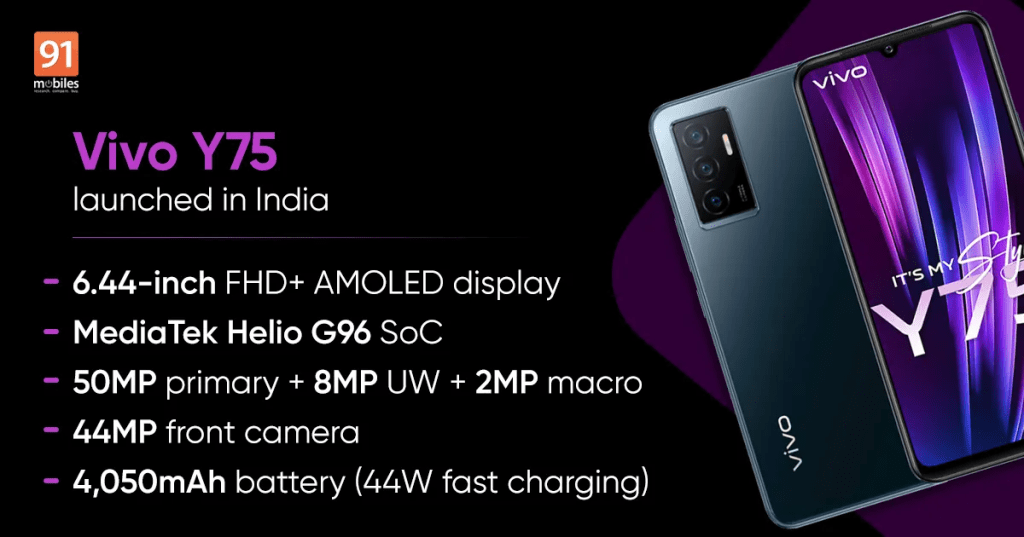
Vivo Y75 4G launched in india with MediaTek Helio G96 chipset, 44 MP selfie cam

The new Y75 comes with a 6.44-inch 1080×2400 AMOLED screen with a 60 Hz refresh rate, the MediaTek Helio G96 SoC at the helm, and 8GB of RAM, 128 GB of expandable storage

After earlier announcing the Vivo Y75 5G officially, the company has finally also unveiled the 4G variant of the Android smartphone.

  • Vivo Y75 price in India, availability

The price of Vivo Y75 in India has been set at Rs. 20,999 for the sole 8GB RAM + 128GB storage variant. The phone comes in Dancing Waves and Moonlight Shadow colors and is now available for purchase through Flipkart, Vivo E-Store as well as offline retail stores.

Customers purchasing the smartphone using cards of ICICI, SBI, IDFC First Bank and OneCard can avail up to Rs. 1,500 discount as well.

  • Vivo Y75 specifications

The dual-SIM (Nano) Vivo Y75 runs on Funtouch OS 12, based on Android 11. The smartphone sports a 6.44 inch full-HD+ (1,080×2,400 pixels) AMOLED display. The Vivo Y-series phone is powered by a MediaTek Helio G96 4G SoC under the hood, paired with 8GB of RAM. The RAM can be extended up to 4GB using the additional inbuilt storage.

For optics, there is a triple rear camera setup along with a rear flash. The camera unit houses a 50-megapixel primary sensor with an f/1.8 aperture, an 8-megapixel wide-angle depth sensor with an f/2.2 aperture, and a 2-megapixel macro sensor with an f/2.4 aperture. For selfies and video chats, the Vivo Y75 has a 44-megapixel autofocus sensor at the front. The camera unit of Vivo Y75 comes preloaded with a list of camera modes, including ultra-wide night, super macro, portrait mode, live photo and bokeh mode among others. The smartphone has 128GB of inbuilt storage, which can be expanded via a microSD card.

Connectivity options on the Vivo Y75 include Wi-Fi, Bluetooth v5.2, GPS, BEIDOU, GLONASS, GALILEO, 3.5mm headphone jack and a USB Type-C port. Sensors onboard include an accelerometer, ambient light sensor, gyroscope, proximity sensor, and e-compass. The phone also comes with a fingerprint sensor for authentication.

The new Vivo Y75 packs a 4,050mAh battery with support for 44W flash charging via a bundled charger. The Moonlight Shadow colour variant of Vivo Y75 measures 160.87×74.28×7.36mm, while the Dancing Waves variant measures 160.87×74.28×7.41mm. The smartphone weighs 172 grams.

Design a site like this with WordPress.com
Get started