WHAT IS TWO-FACTOR AUTHENTICATION?

A strong password is essential to keep your online data safe. But with increasing cyberattacks, you need two-factor authentication, which adds an extra layer of security to your online accounts

At its annual developer’s conference this year, American tech giant Apple introduced Passkey – a new sign-in technology.

Passkeys give people a secure way to sign in to your apps and websites across platforms — with no passwords required that promises to be more secure than passwords. Though a step in the right direction, the technology is unlikely to replace password-based authentication systems, just yet. Password-based authentication systems, however, are rife with security concerns.

If you only use a password to authenticate, it leaves an insecure vector for attack. If the password is weak or has been exposed elsewhere, an attacker could use it to gain access.

That said, passwords are the least secure method for authentication if used as a standalone. The security increases if another form of authentication is added along with passwords – we’re talking of two-factor authentication.

Two-factor authentication is a process in which users are prompted during the sign-in for additional identification, beside passwords. This additional form of identification could be done through a one-time pin received on the phone via SMS, biometric scan, security key, nearby device etc.

The additional authentication adds a layer of security to the password-based sign-in process by enabling additional identity verification, such as scanning a fingerprint or entering a code received on the phone.

Two-factor authentication

One of the easiest ways to enable two-factor authentication is by linking the sign-in service with a phone number. This way, you would need to enter the password and additionally authenticate the sign-in by entering a code received on the phone number. For smartphone users, there are authenticator apps to approve sign-ins using push notifications, biometrics, or one-time passcodes.

For enterprises, there is a standard called FIDO2 issued by the Fast IDentity Online (FIDO) Alliance to promote open authentication standards and reduce the use of passwords as a form of authentication. It is typically a USB device, or a device with Bluetooth or near-field communication chip in some cases, configured with a security key.

These devices, when connected to the system, enable password-less authentication. With a hardware device that handles the authentication, the security of an account is increased as there is no password that could be exposed or guessed.
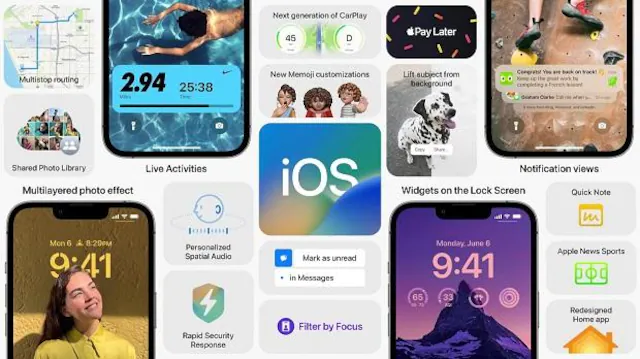
What’s new coming to Apple platforms later this year?

Apple Inc on Monday lifted the curtain on its latest processor, the M2. Free software upgrades were also unveiled and will be available in September. Find out about their features

Let us begin with the much-awaited iOS 16. First, the not-so-good-news. Those using iPhone 7 or earlier version will not be able to upgrade to iOS 16.

Apple has included a lot of attractive features in the new iOS. Your lock screen will now become trendier. You will be able to see your calendar events, weather and other customizable information without unlocking the device. Android phones had it, and Apple users wanted it too for long. It will support widgets to show information at a glance such as upcoming calendar events, weather, battery levels, alarms, time zones, etc.

The iOS 16 will also allow you to edit and recall sent messages in the Messages app. But you can do it for the first 15 minutes. You will also be able to mark your messages as unread just like the emails.

In addition, SharePlay is coming to messages. Likewise, the Mail app is set to bring new mail experience with features like schedule, recall, remind later, follow up suggestions, and more.

The next version of the operating system for Apple tablets brings new capabilities, especially for M1 chip-powered iPads. It will bring the Stage Manager feature, which will enable desktop-class multitasking with multiple overlapping windows.

Designed for easy collaboration, the iPadOS 16 will debut Apple’s Freeform app for people to brainstorm together on a flexible canvas.

Like iOS 16, the iPadOS 16 will get new tools in the Mail app such as schedule, recall, remind later, follow up suggestions, and more. Safari browser on the iPadOS 16 will get a shared Tab Groups feature, which will allow easy collaboration by enabling web browsing with others.

iPadOS 16 will be available this fall as a free software update for iPad (5th generation and later), iPad mini (5th generation and later), iPad Air (3rd generation and later), and all iPad Pro models.

The watchOS 9 comes with several health and fitness features. It will bring an updated Workout app, with new advanced metrics, views, and training experiences inspired by high-performing athletes.

It comes with a new FDA-cleared ‘AFib History’ feature which allows users to monitor the state of atrial fibrillation over a period of time.

As for the apps, the watchOS 9 will debut the ‘Medications app’, which is touted by the company as a convenient tool for users to discreetly manage, understand, and track medications.

watchOS 9 will be available this fall for Apple Watch Series 4 or later paired with iPhone 8 or later and iPhone SE (second generation) or later, running iOS 16.

The next version of macOS will bring small but meaningful upgrades with regard to continuity. It will debut the ‘Continuity Camera’ feature, which will allow users to use iPhone as the webcam on Mac. Another continuity feature is Handoff, which is coming to FaceTime. It will allow users to start a FaceTime call on their iPhone or iPad and fluidly pass it over to their Mac.

Besides previewing the upcoming platforms, Apple introduced the MacBook Air and upgraded the 13-inch MacBook Pro – both powered by the newly introduced M2 silicon. The new M2 chips are 40% faster than the previous generation

While the Pro model is similar to the last generation model in terms of design, the new MacBook Air M2 brings a redesigned chassis which is 11.3 mm thick and weighs about 1.22g. It features a 13.6-inch liquid retina display, a 1080p FaceTime HD camera, four-speaker sound system, and MagSafe charging. It will be available in India from July in four finishes — silver, space gray, midnight, and starlight.

Staying true to its legacy, Apple continues to innovate and churn out better products every year. The new lot which will hit the markets later this year also looks promising, offering cutting edge technology and a great user experience to all those who can afford it.

Design a site like this with WordPress.com
Get started